> ## Documentation Index
> Fetch the complete documentation index at: https://wundergraphinc-brendan-add-sof-link.mintlify.site/llms.txt
> Use this file to discover all available pages before exploring further.
# Subgraph Check Extensions
> Validate schema changes before deploying them to production on your own premises.
A subgraph check extension allows you to validate whether a proposed schema change will produce any errors before
deploying it to production with your own validator.
## Use cases
This feature comes in handy when you want to ensure that your subgraphs adhere to your company's policies or standards
outside what Cosmo offers out of the box. For example, you might want to ensure that all types and fields follow a
certain naming convention.
Another use case is to hook subgraph check into additional pipelines in your system to ensure that the proposed changes
are valid and follow the expected standards before they are deployed to production. For example, if your development team
introduces a breaking change that is expected, a notification can be sent to your frontend team so they can be aware
of the upcoming change.
## How it works
When the Subgraph Check extension is enabled for a namespace, each time a check runs against a graph in that namespace,
a request is sent to the [configured endpoint](#configuration). This request includes details about
the check and allows you to define additional lint issues or return error messages that can cause the check to fail.
### Request
The request is sent using the `POST` method with a `JSON` body. You can learn more about the request structure on
the [request payload structure](/studio/sce/request-payload-structure) page.
### Response
We use the status code to determine whether the request was successful or not. We expect the status code `200` or `204`.
Any other status code is considered a failure and is displayed as such on the checks page.
When we receive a `200` status code, we'll validate that the response body matches the expected
[response structure](/studio/sce/response-structure). If the response cannot be validated, we consider the check a failure.
A status code of `204` indicates that the request was successful but no further action is required. This can be
useful when you don't want to perform any check and don't want the check to fail.
## Configuration
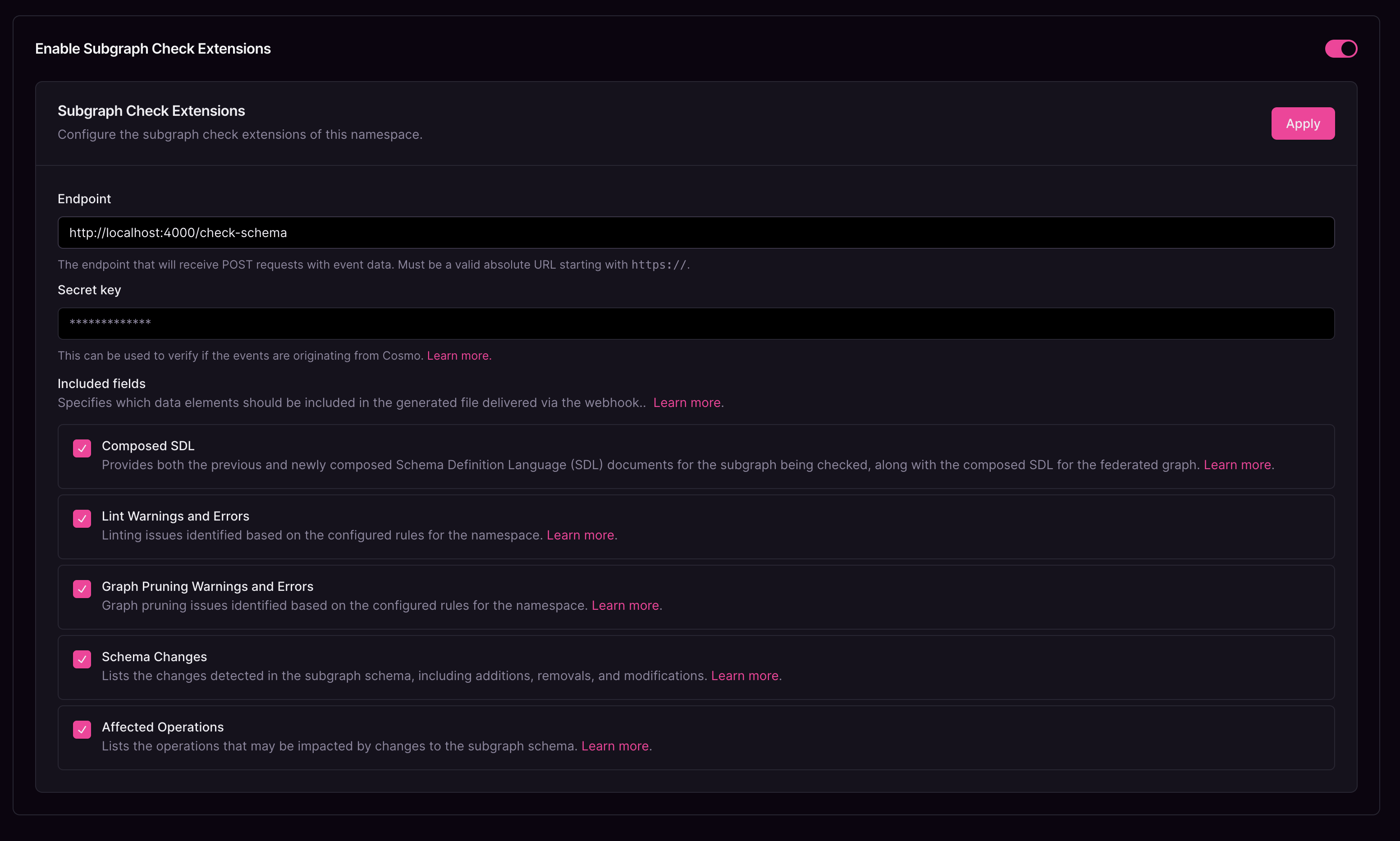 ### Endpoint
The URL to which each request is sent. This endpoint must be accessible from Cosmo.
### Secret Key
A value used to generate the request signature when sending data to the configured endpoint. This signature
helps [verify](#verification) that the request originates from Cosmo and has not been altered.
### Include Composed SDL
When enabled, both the previous and current SDL (Schema Definition Language) versions are sent to your service.
### Include Lint Warnings and Errors
When enabled, all detected lint issues are sent to your service.
To receive warnings and errors, you must enable [Linter Rules](/studio/lint-policy/linter-rules) for the namespace.
### Include Graph Pruning Warnings and Errors
When enabled, all detected graph pruning issues are sent to your service.
To receive warnings and errors, you must enable [Graph Pruning](/studio/graph-pruning) for the namespace.
### Include Schema Changes
When enabled, details of schema changes are included in the data sent to your service.
### Include Affected Operations
When enabled, information about affected operations is included in the data sent to your service.
## Verification
To ensure the payload data comes from a trusted source and hasn’t been tampered with during transit, we employ HMAC
signatures. When setting up the *Subgraph Check Extension* for a namespace, you can provide a secret key. This
secret key is used to compute a signature that is sent along with each request.
The header containing this signature is `X-Cosmo-Signature-256`.
### Verification Example
To verify the request, compute the HMAC signature on your server and compare it to the signature in the
`X-Cosmo-Signature-256` header.
Here’s an example in Node.js:
```typescript theme={null}
import crypto from 'crypto';
function verifySignature(body, receivedSignature, secret) {
const computedSignature = crypto
.createHmac('sha256', secret)
.update(body)
.digest('hex');
return computedSignature === receivedSignature;
}
// Usage:
const isVerified = verifySignature(JSON.stringify(req.body), req.headers['x-cosmo-signature-256'], YOUR_SECRET);
```
### Endpoint
The URL to which each request is sent. This endpoint must be accessible from Cosmo.
### Secret Key
A value used to generate the request signature when sending data to the configured endpoint. This signature
helps [verify](#verification) that the request originates from Cosmo and has not been altered.
### Include Composed SDL
When enabled, both the previous and current SDL (Schema Definition Language) versions are sent to your service.
### Include Lint Warnings and Errors
When enabled, all detected lint issues are sent to your service.
To receive warnings and errors, you must enable [Linter Rules](/studio/lint-policy/linter-rules) for the namespace.
### Include Graph Pruning Warnings and Errors
When enabled, all detected graph pruning issues are sent to your service.
To receive warnings and errors, you must enable [Graph Pruning](/studio/graph-pruning) for the namespace.
### Include Schema Changes
When enabled, details of schema changes are included in the data sent to your service.
### Include Affected Operations
When enabled, information about affected operations is included in the data sent to your service.
## Verification
To ensure the payload data comes from a trusted source and hasn’t been tampered with during transit, we employ HMAC
signatures. When setting up the *Subgraph Check Extension* for a namespace, you can provide a secret key. This
secret key is used to compute a signature that is sent along with each request.
The header containing this signature is `X-Cosmo-Signature-256`.
### Verification Example
To verify the request, compute the HMAC signature on your server and compare it to the signature in the
`X-Cosmo-Signature-256` header.
Here’s an example in Node.js:
```typescript theme={null}
import crypto from 'crypto';
function verifySignature(body, receivedSignature, secret) {
const computedSignature = crypto
.createHmac('sha256', secret)
.update(body)
.digest('hex');
return computedSignature === receivedSignature;
}
// Usage:
const isVerified = verifySignature(JSON.stringify(req.body), req.headers['x-cosmo-signature-256'], YOUR_SECRET);
```